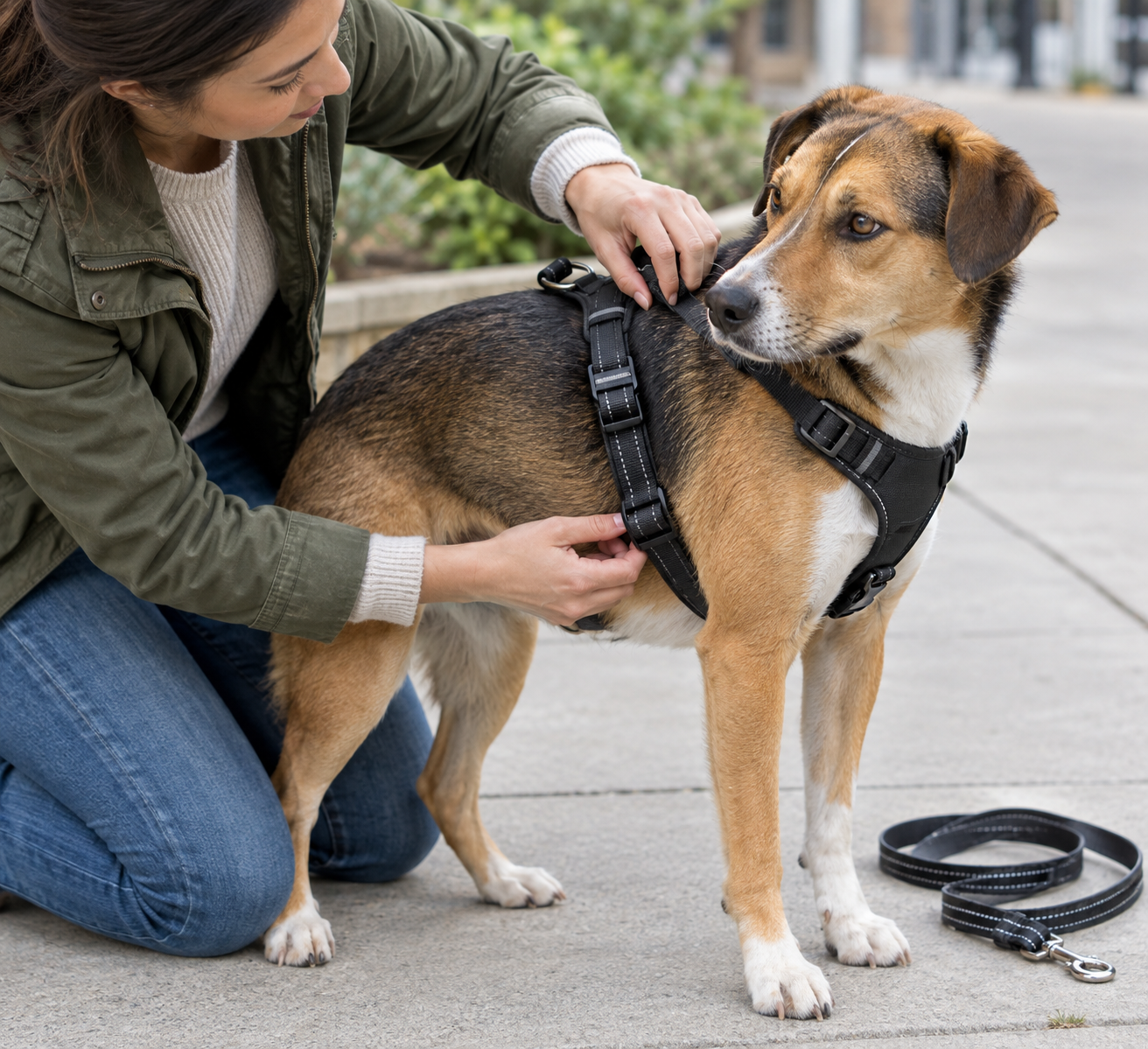
How to Put On a Dog Harness: Steps for Every Type
A buckled harness that slides forward over the head leaves you holding a leash while your dog stands loose on the sidewalk. A dog can walk out of an expensive harness as easily as a cheap one if the straps were set wrong on day one, and the mistake is rarely visible until the dog backs up.
We went through the American Kennel Club’s fitting steps, the fit advice from harness makers and a veterinary clinic, and a 2025 scientific review of 21 papers and two abstracts on walking equipment. Below are the steps for four harness styles, three checks to run afterward, and a table of eight fitting problems. We did not test harnesses ourselves.
Our view: the pull test matters most, because it is the check that targets escape. The famous two-finger rule is useful, but it is a convention and not a measured standard.
Which harness do you have?
| What you see | Style | Where the leash clips | How it goes on |
|---|---|---|---|
| A neck loop, a rib loop and a ring on the back | Standard (overhead) | Back | Over the head, one leg through, buckle |
| Two triangles when laid flat | Step-in | Back, usually | Front feet in, clip on the back |
| One rib loop and one chest strap, nothing between the legs | Front-clip, chest-strap style | Center of the chest | Over the head, fasten under the belly |
| A padded panel across the chest | Vest | Depends on the model | Follow the label; makers build these as step-in or overhead |
If your harness has rings at both the chest and the back, it can be used either way. Which one to use depends on whether your dog pulls, and our front-clip vs back-clip comparison sets out the evidence.
Before the first fitting
- Loosen every strap. The AKC notes that a buckle that will not reach simply means the strap needs loosening.
- Pick a calm moment. The AKC advises fitting a calm dog, and Chewy’s guide adds treats to keep the dog still while you measure with a soft tape.
- Compare your measurements with the size chart for that exact model. Sizing is not shared across brands, and listings give different combinations of neck, chest and girth.
How to put on a standard harness
- Stand, sit or squat behind your dog while they stand or sit.
- Slip the harness over the head with the D-ring on the back. The wider loop with the buckle goes on first.
- Bring one front leg through the first leg hole, so it sits between the rib loop and the neck loop.
- Buckle it, which places the other leg in its opening.
- Adjust the straps, then run the three checks below.
How to put on a step-in harness
- Lay it flat so you can see both triangles, with the buckles on top of the D-rings.
- From behind your dog, place each front foot in a triangle.
- Lift the two ends and clip them together on the back.
- Adjust, then run the checks. A step-in spares a dog who dislikes things going over the head.
How to put on a front-clip harness
Some front-clip harnesses are shaped like a standard or step-in harness, so use those steps. For the chest-strap style:
- Kneel at your dog’s right side while they sit or stand calmly.
- Put the loop over the head. The AKC places the label on the left shoulder and the metal ring at the center of the chest.
- Reach under the belly and fasten the strap.
- Adjust, then run the checks.
How to put on a vest harness
Vests vary more than the other styles, so the maker’s diagram wins here. EzyDog, which sells them, describes opening the closures, placing the vest on the dog and fastening each one before the final fit check. Hook-and-loop closures can loosen, so press them flat and check that the buckle carries the load if there is one. That last point is our suggestion.
The three checks to run every time
- Two fingers. Slide two fingers under each strap. Kurgo says two and only two. The 2025 review reports the usual advice as one or two.
- The pull test. Try to draw the buckled harness forward over the head. The AKC uses this to confirm the harness is secure.
- The walk check. Watch the first few minutes for a shortened stride, then feel behind the front legs for heat or rubbing. This is our own routine, not a study protocol.
What each fitting problem means
This table is our own synthesis of the sources below. Treat it as a starting point, and see your vet if the skin is broken or your dog is limping.
| What you notice | Likely cause | What to try |
|---|---|---|
| Harness comes off in the pull test | Neck or chest straps too loose | Tighten, retest, then try a smaller size |
| Dog backs out on walks | Loose fit or a design that does not suit the body | Refit, then consider a style with more adjustment points |
| Rubbing or hair loss behind the legs | Strap sits in the armpit or the harness shifts | Refit; change style if it returns |
| Harness sits lopsided | Uneven straps or a twisted strap | Remove it, flatten the straps, even both sides |
| Buckle will not reach | Strap too tight, or the wrong size | Loosen fully, then check the chart |
| Ring ends up in the wrong place | Harness is on backward | Start again and check where the ring should sit |
| Dog freezes when it goes on | Unfamiliar feeling | Short indoor sessions with treats |
| Straps need retightening often | Growth, weight change or worn hardware | Remeasure and inspect it |
Where the common advice has no evidence
Most fitting advice is passed from one guide to the next. The authors of the 2025 review in Animals say published guidance is mostly descriptive and seems grounded in common sense, usually without supporting evidence. They also note a lack of injury data, so no one can yet say how often a poor fit harms a dog.
- The finger rule: we found no study that tested it. It remains a sensible way to compare straps.
- “Never cross the shoulder”: widely repeated, but one treadmill study of nine dogs found a Y-shaped harness restricted shoulder extension more than a strap across the chest.
- “This harness is the most comfortable”: the review found no device that suits every dog.
Puppies and growing dogs
Knightdale Animal Hospital warns that a harness left on a growing puppy can become embedded in the skin, causing wounds and infection. Its advice is to use one only when needed, such as for walks and vet visits, and to adjust or replace it as the puppy grows. Measure often, and do not leave it on unsupervised, which EzyDog also advises.
Getting your dog to accept it
- Put the harness on the floor and let your dog sniff it.
- Reward your dog for standing near it, then for putting a nose or paw through.
- Do it up indoors for a short session, followed by something your dog likes.
- Go outside once your dog moves normally. The review’s authors note that reward-based training can help dogs get comfortable with equipment.
Questions owners ask
How tight should a dog harness be?
A dog harness should be tight enough that it cannot be pulled over the head, with room for about two fingers under each strap.
How do I know if a harness is on backward?
You know a harness is on backward when the ring is in the wrong place. A standard harness has it on the back, and a chest-strap front-clip has it at the center of the chest.
Should a dog wear a harness all day?
A dog should not wear a harness all day unsupervised. Knightdale Animal Hospital and EzyDog both favor taking it off when it is not needed, and it should also be checked for damage.
Can I use my walking harness in the car?
You can buckle one in, but that does not make it crash protection. The Center for Pet Safety keeps a list of certified models, which you should check by exact model and size.
Does a harness replace leash training?
A harness does not replace leash training. Chewy’s guide treats it as a complement, and the 2025 review puts training at the center of addressing pulling.
For brand and warranty comparisons, see our ranking of 12 harness brands.
References
- American Kennel Club, How to Put on a Dog Harness (updated February 2026)
- Cavalli C, Protopopova A. Review of Collars, Harnesses, and Head Collars for Walking Dogs. Animals, 2025;15(15):2162
- Lafuente MP, Provis L, Schmalz EA. Effects of restrictive and non-restrictive harnesses on shoulder extension in dogs at walk and trot. Veterinary Record, 2019;184(2):64
- Knightdale Animal Hospital, Properly Choose and Put On a Dog Harness
- Kurgo, 3 Easy Steps to Put On a Dog Harness (maker guidance)
- EzyDog, How to Put On a Dog Harness (maker guidance)
- Center for Pet Safety, CPS Certified Products
Woof & Honest was not paid for this article and received no products or brand deals for it. Claims trace to the published sources listed above, makers are named where the advice is theirs, and we did not test these products ourselves.
This article is general information, not veterinary advice. If your dog seems sore or unwell, ask your vet.